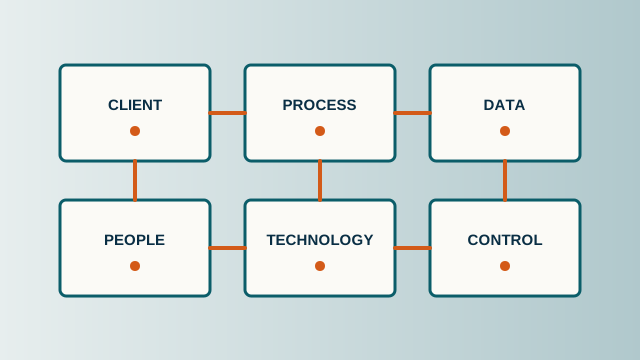
The best payments strategies reduce client friction, embed the institution in daily workflows, improve data, and strengthen control at the same time.
Modernize the Journey, Not Only the Rail
Payments modernization is often framed as a choice among rails, processors, APIs, and real-time capabilities. Those decisions matter, but clients experience a journey: setup, authorization, funding, exception handling, reconciliation, reporting, support, and control.
A modern payment product should reduce the work required to initiate, understand, approve, reconcile, and resolve a transaction. Faster movement of money is useful; faster movement of confusion is not.
Become Part of the Client’s Workflow
Commercial clients do not want to rekey the same information across their accounting system, treasury portal, approval process, and reporting tools. The strongest solutions connect naturally to the way clients already operate.
File integration, APIs, ERP connectivity, event notifications, and actionable reporting can make the financial-services provider part of the client’s daily control environment. That creates value through accuracy, timeliness, reduced friction, and greater relationship durability.
Make Data a Product
Payment data should do more than prove that a transaction occurred. It can support cash visibility, forecasting, anomaly detection, client service, relationship intelligence, exception prioritization, and product design.
That requires clean identifiers, consistent metadata, timely availability, clear ownership, and integration into the workflows where decisions are made. Data trapped in reports is not yet a capability.
Design Fraud and Compliance Into the Experience
Controls added after the product design often create friction without creating proportional risk reduction. Better design considers authentication, entitlements, limits, behavioral signals, approvals, sanctions, fraud response, and customer communication as part of the experience.
The goal is not the lowest possible friction or the highest possible friction. It is intelligent friction that increases with risk and remains understandable to the customer and the employee.
Measure Relationship and Operating Value
Volume is an important measure, but it is incomplete. Leaders should also examine activation, time-to-first-value, product adoption, exception rates, support effort, fraud losses, fee income, deposit behavior, cross-sell, retention, and the cost to serve each segment.
Payments modernization creates competitive advantage when it deepens the relationship and improves the institution’s ability to operate, learn, and scale—not simply when a new feature reaches production.
What leaders should carry forward
- 01
Design around the complete client and operating journey.
- 02
Use integration and data to become part of the client’s daily workflow.
- 03
Measure relationship depth, operating leverage, and risk—not only transaction volume.

Matthew March
Matthew March is a financial-services technology executive, board director, Fractional CISO, and adviser with more than 25 years of experience connecting technology strategy to growth, resilience, governance, and enterprise value.
Read Matthew’s Story